

Bedrock City
Some childhood memories come back as a whole scene. Others need only a name.
Bedrock City. The Game Farm. Scandia. The floating bridge.
If you grew up in the Okanagan in the 1980s or 1990s, your version of home probably includes places that have disappeared, places that have changed, and a few that can still make you feel ten years old. Depending on where you lived, a trip down the valley might have meant a special outing or simply the familiar landmarks outside the car window.
These 17 memories reach from Enderby and Armstrong to the South Okanagan. Some span both decades; a few belong specifically to the later ’90s. All have a real place in the valley’s history.
1. Forty Foot Fred pointing the way to Bedrock City
Before you reached the entrance, there was Fred.
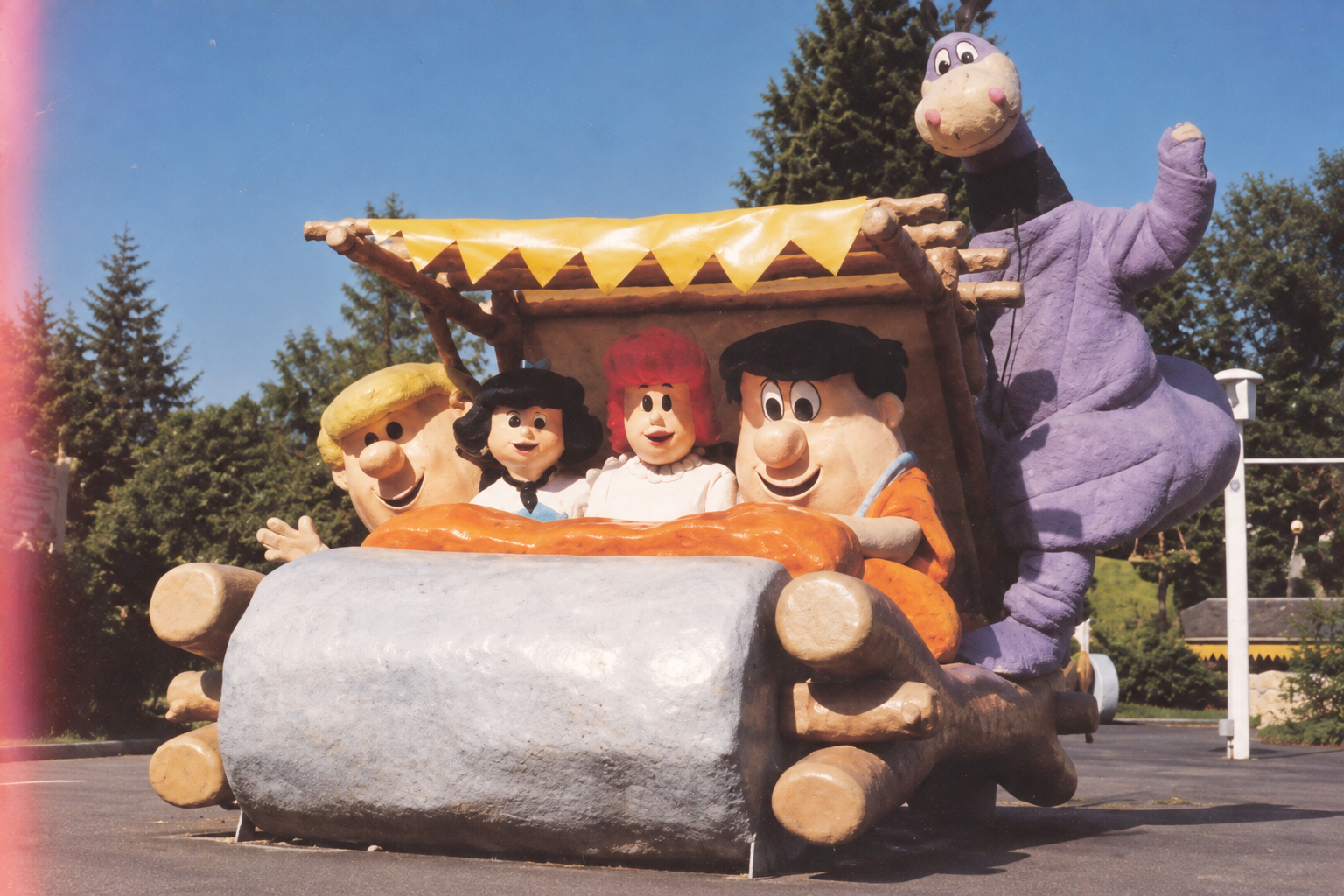
The enormous plywood Fred Flintstone at Highway 97 and McCurdy Road made Kelowna’s Bedrock City difficult to miss. Inside were cartoon-inspired buildings and attractions, including a train, boat ride and miniature golf. It was a place where a television cartoon became somewhere you could actually walk around.
There is a wonderfully specific story behind that roadside landmark: the founder’s daughter recalled that her father got around a restriction on signage by classifying Fred as a lawn ornament. A rather ambitious one.
The park closed in 1998, but its oversized greeter remains an excellent test of an old Kelowna photograph. Source: founder’s family interview, iNFOnews.
2. Seeing giraffes at the Okanagan Game Farm
Yes, there really were giraffes in the South Okanagan. Rhinos, too.
The Okanagan Game Farm near Kaleden opened in 1967 and was still operating through the ’80s and most of the ’90s. Former manager Hugh Oakes described a collection of roughly 1,200 animals representing 130 species, on land leased from the Penticton Indian Band. Visitors could travel through the property in their own vehicles, stopping to look at the animals.
For anyone whose childhood photo collection includes an unlikely-looking wildlife outing near Penticton, this may be the missing location. Those pictures were not necessarily taken on a much more distant holiday. Source: former manager interview, iNFOnews.
3. The waterslide parks you still compare everything with
Wild Waters and Wild ’N Wet were two different places, and the distinction matters when everyone starts reminiscing.
Wild Waters operated at McCurdy Road and Highway 97 in Kelowna from 1981 to 1998. Across the lake, Westbank’s Wild ’N Wet offered its own collection of slides, pools and a ravine river ride.
A Kelowna Museums account describes Wild Waters as more than slides: there were also miniature golf, video games and hot tubs. That helps explain why a visit could become a whole family outing, even when not everyone wanted to spend the day hurtling downhill.
Which one was your family’s favourite? This is precisely the sort of question that can restart a decades-old argument. Source: iNFOnews, with Kelowna Museums historical information.
4. Mini-golf, arcade games and birthday parties at Scandia
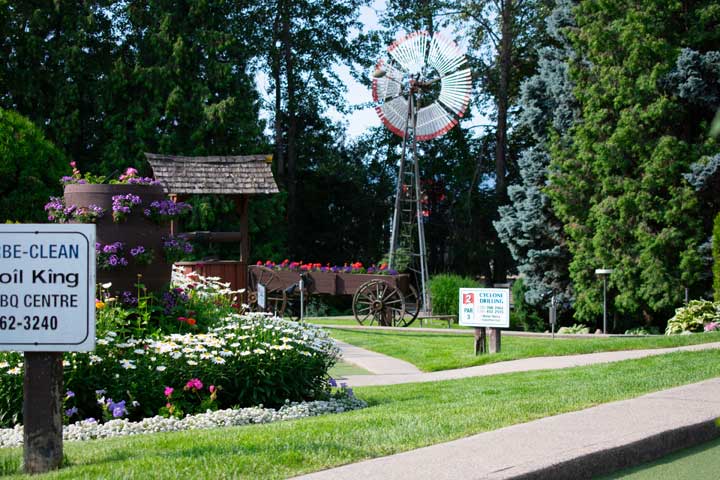
The castle. The windmill. The serious business of a very small golf ball.
Scandia opened in Kelowna in 1981, after Hank and Doreen Wiebe developed the idea with friends and business partners. Its indoor Jungle Golf was part of the attraction from the beginning, while its birthday-party history includes those automated animal performers that some people remember almost as clearly as the games.
The attractions have evolved, but the name still carries a very particular promise: a family outing in which everyone can become surprisingly competitive. If you have an old Scandia birthday photo, look past the cake. The background may be the real nostalgia prize. Source: Scandia history, iNFOnews.
5. Crossing the original floating bridge
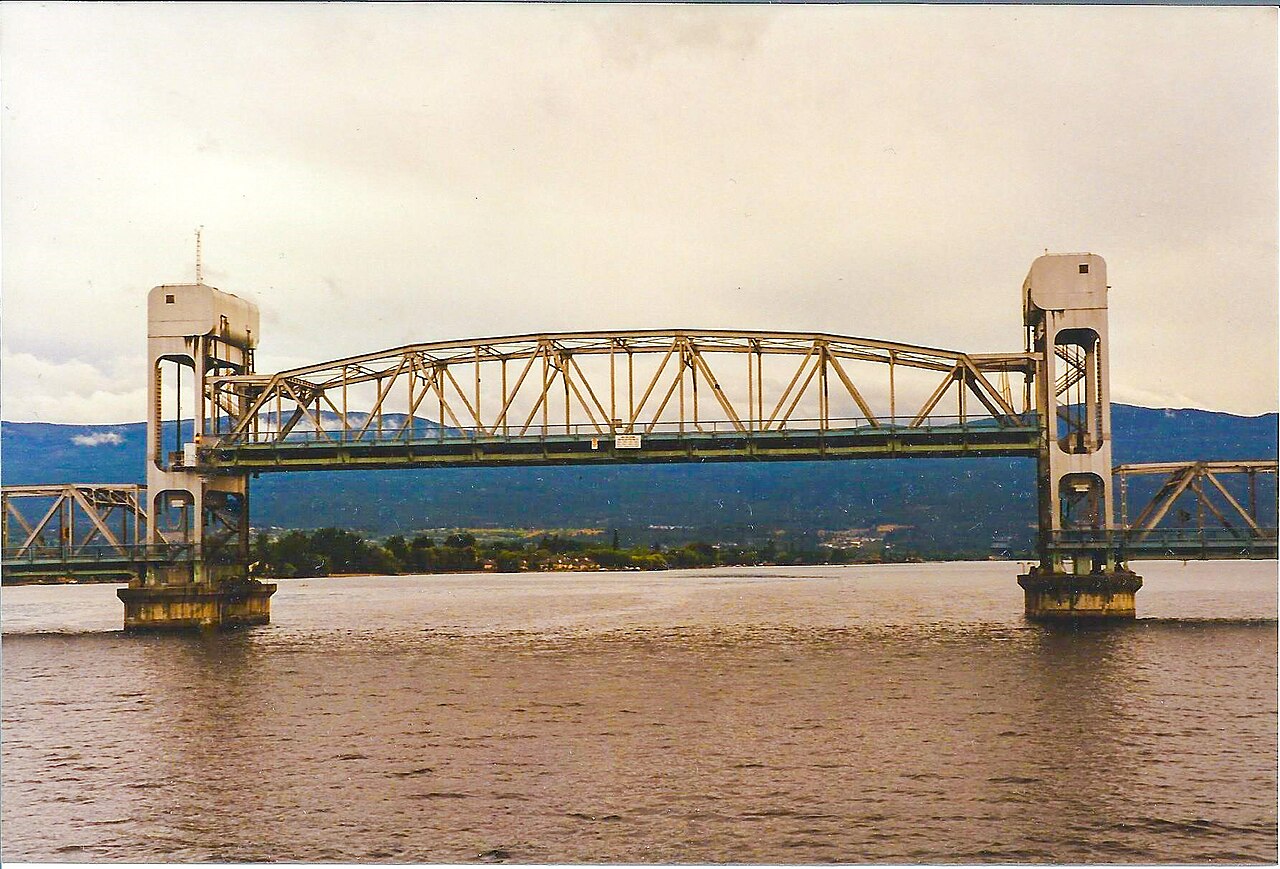

The bridge in an ’80s or ’90s family video is not the one carrying traffic today.
The original Okanagan Lake Bridge opened in 1958. A third lane was added in August 1984, giving the crossing its familiar three-lane arrangement. It also had a lifting section to allow taller vessels through, a feature that made the bridge itself part of the journey.
Its replacement opened in 2008. For people who grew up with the old crossing, photographs of that low strip across the lake can bring back an entire drive: where you were going, who was at the wheel, and which side of the lake meant home. Sources: Okanagan Historical Society, B.C. government bridge history.
6. A movie at Kelowna’s Paramount Theatre
Some buildings hold a surprising amount of teenage history.
The Paramount on Bernard Avenue opened in 1949 and became part of downtown Kelowna’s movie-going life for generations. Landmark Cinemas took it over in 1987; its final screenings came in March 2016.
For an ’80s or ’90s kid, the important date might be something much more personal: your first movie without your parents, a birthday outing, or a date for which you remember the company better than the film.
The theatre’s history is also a reminder that an ordinary night out can become the thing you miss most when a familiar place disappears. Source: KelownaNow’s closing report.
7. The giant Peach on Penticton’s waterfront
.jpg)
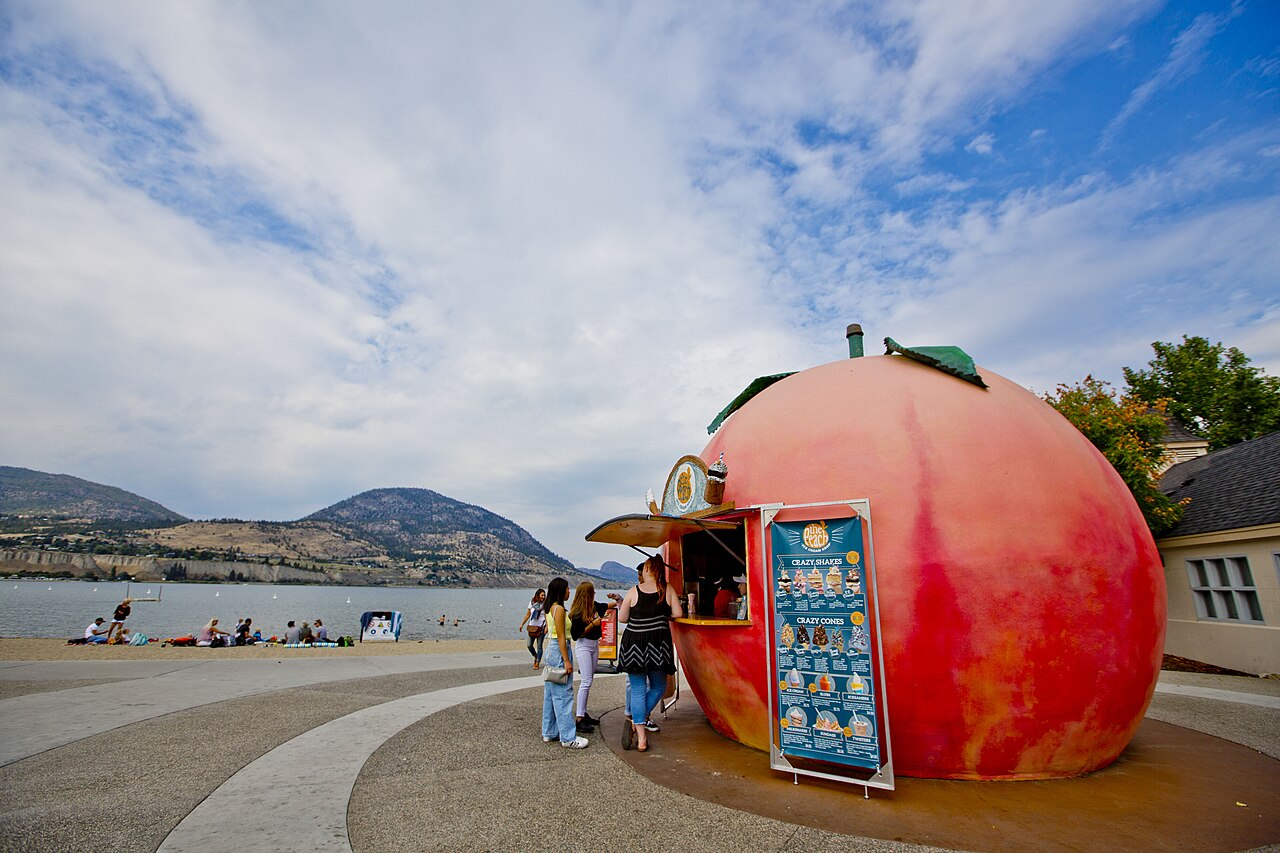
A concession stand is useful. A concession stand shaped like an enormous peach is a landmark.
Penticton’s museum history records that Bob Gordon built two peach-shaped concession stands in 1963. The waterfront Peach became an unmistakable part of the city’s identity, already well established by the time ’80s and ’90s kids came along.
It is the kind of object that makes a family photograph instantly recognisable. You do not need a street sign, a date stamp or someone’s handwritten note on the back. A very large piece of fruit does the job nicely. Source: City of Penticton heritage tour.
8. Going for a spin at Malibu Grand Prix
Before you could drive a real car, a go-kart track offered a pretty convincing taste of independence. Hands on the wheel. Eyes on the next corner. Suddenly, being the passenger wasn’t the only option.
Kelowna’s Malibu Grand Prix opened in 1985 on Stremel Road, just off Highway 97. Run by the Prowse family, it gave local kids and visiting families a place to swap the back seat for the driver’s seat.
Later known as Kelowna Grand Prix, it closed in October 2013. You can still float the channel, but this particular childhood pit stop belongs to the memory bank. Sources: KelownaNow, Global News.
9. The South Okanagan ice-cream stops
Some journeys are remembered by the scenery. Others are remembered by where you stopped for ice cream.
Tickleberry’s belongs especially to ’90s childhoods: Dale and Jenette Hoy began the business as a Yukon jam venture in 1987, then opened their Okanagan Falls ice-cream parlour in spring 1990.
Farther south, Osoyoos had the Windmill ice-cream parlour from 1974. It later became part of Rattlesnake Canyon when the amusement park opened in 1998.
Different stops, same difficult childhood decision: choosing a flavour while suddenly becoming concerned that everyone else might choose a better one. Sources: Tickleberry’s own history, Windmill history in a business-sponsored Castanet feature.
10. Orchard Park when Woolco was part of the picture
An old mall photograph can be a surprisingly effective time machine. Sometimes one store sign is enough.
Orchard Park opened in 1971, with Simpsons-Sears among its original anchors and The Bay following in 1972. Woolco arrived with the 1980 expansion, making it part of the mall landscape that many ’80s kids knew.
Your own memory might centre on a shopping trip, meeting a friend, or being taken along on an errand that seemed to last much longer than necessary. The familiar mall name survived; the collection of storefronts in your head belongs to a particular version of Kelowna. Source: Orchard Park anniversary history.
11. Getting your picture taken with Ogopogo
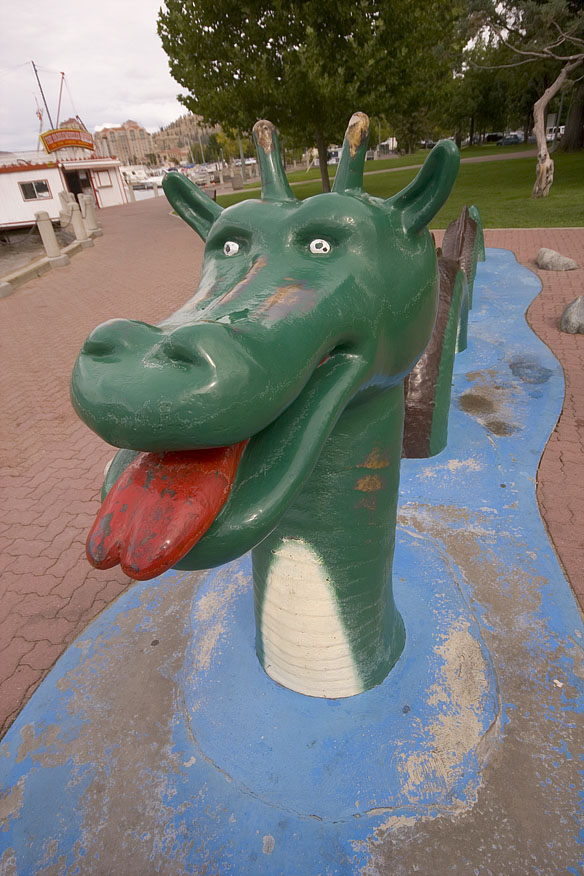

Long before a waterfront photo was destined for social media, it could be destined for the family album.
Peter Soelin’s Ogopogo sculpture dates to 1960, making it an established Kelowna landmark throughout both decades. It has been refreshed and relocated over the years, so the background in an old photograph can be part of the story, too.
For this memory, we mean the familiar tourist sculpture. The commercial Ogopogo character should not be confused with the deeper syilx Okanagan teachings about the lake and nx̌aʔx̌ʔitkʷ, which Tourism Kelowna encourages visitors to learn about through the Sncewips Heritage Museum.
The family-album question is simpler: who still has the picture? Source: Tourism Kelowna’s public-art history.
12. Going to the IPE in Armstrong
For an outing with a very different rhythm from a lake day, there was the Interior Provincial Exhibition.
The IPE’s roots are agricultural: a place to bring produce and livestock, compare results and celebrate the work of the surrounding farming community. Its history stretches back long before the ’80s and ’90s, and its published prize records include exhibitors from both decades.
That gives an old fair photograph more than one possible story. Were you there to look around, or had somebody in the family entered something? Were you a spectator, a competitor, or a child discovering just how much adults could care about a ribbon? Sources: IPE history, IPE prize book and historical winners.
13. Watching Davison Orchards become a family destination
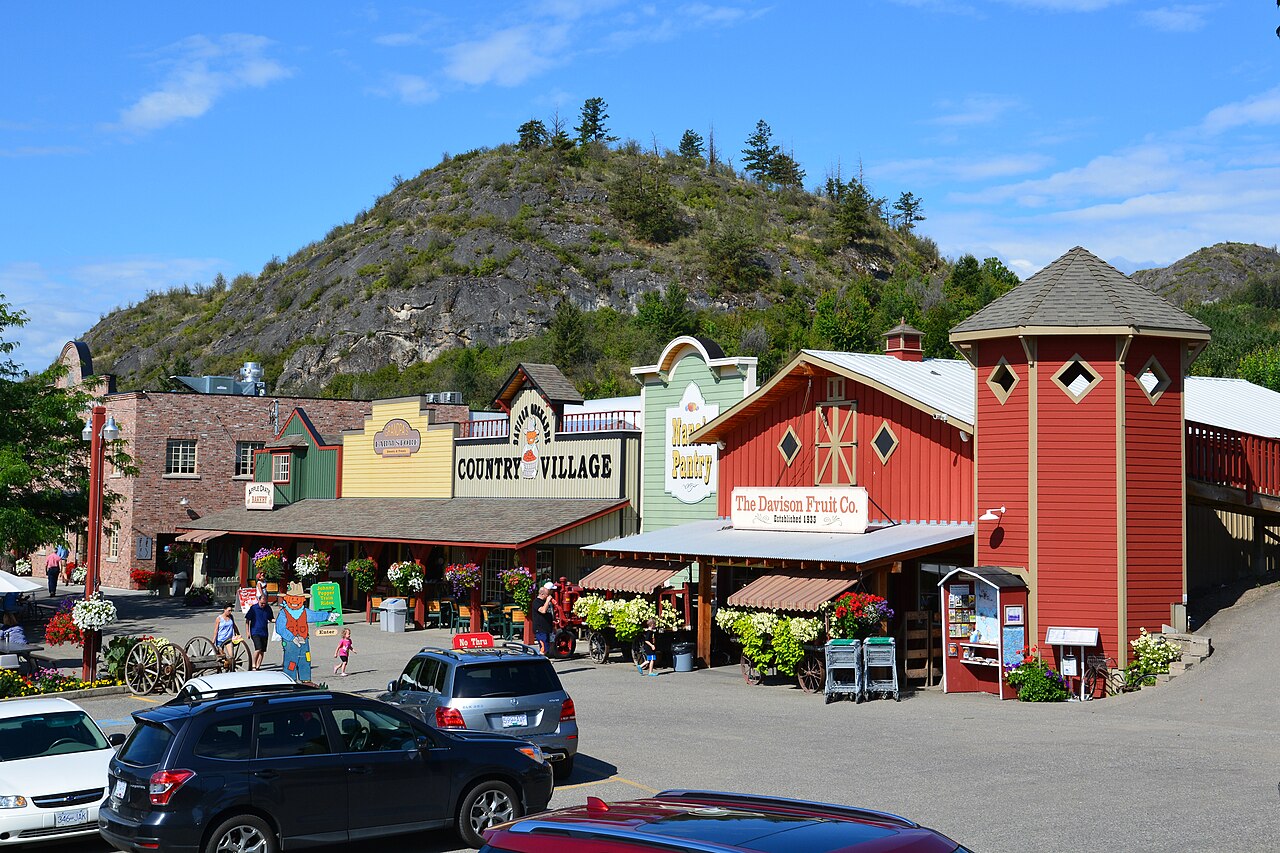

Not every important childhood place began as an amusement park. Some began as a working orchard.
The Davison family has farmed in Vernon since 1933, but 1985 marks the beginning of Davison Orchards Country Village. Tom and Tamra Davison helped develop the farm’s visitor side, which grew to include a shop, bakery and family attractions.
For people who visited in the later ’80s and ’90s, that places their memories inside a particular chapter of the farm’s story. Today’s destination did not arrive fully formed. It grew around an orchard and a family, while other families were growing up alongside it. Source: Davison Orchards’ family history.
14. Jopo, snow sculptures and Vernon Winter Carnival
The Okanagan childhood calendar was not all summer.
Vernon Winter Carnival had its own cast of characters, including Jopo, the carnival jester introduced in 1966. The carnival’s official timeline puts the first Silver Star snow-sculpting contest in 1983 and the start of its Hot Air Balloon Fiesta in 1993.
That last date matters: balloons belong to the ’90s part of this memory, not the beginning of the ’80s.
Whether your family pictures show a parade, a snowy outing or everyone looking impressively bundled up, Winter Carnival offers a reminder that winter had its own occasions worth getting outside for. Source: Vernon Winter Carnival’s official history.
15. When Vernon’s team was the Lakers
Say “Vernon Lakers” and some hockey fans will immediately know which chapter you mean.
The club won back-to-back Centennial Cup national championships in 1990 and 1991. Vernon had also hosted the 1990 tournament. Those were substantial achievements to grow up around, with national-level excitement attached to a local team.
The Vipers name arrived in 1995. So an old programme, jersey or team photograph can place a memory within the decade before you have even found the date.
If somebody in your family saved the programmes, this is an excellent reason to ask where they put them. Source: Vernon Vipers’ official franchise records.
16. A late-’90s movie night at Enderby’s Starlight Drive-In
This one comes with a date check: Enderby’s Starlight opened in 1996.
It belongs on a ’90s list, but it would be wrong to give it a role in someone’s 1982 summer holiday. For children and teenagers around the North Okanagan in the second half of the ’90s, it offered a newer chapter in a much older movie-going tradition.
A drive-in makes the outing bigger than the film. The car becomes part of the occasion; waiting for darkness becomes part of the anticipation. And in a family memory, whether you stayed awake can matter almost as much as what was showing. Source: Starlight owner interview, iNFOnews.
17. The steam railway’s return in Summerland
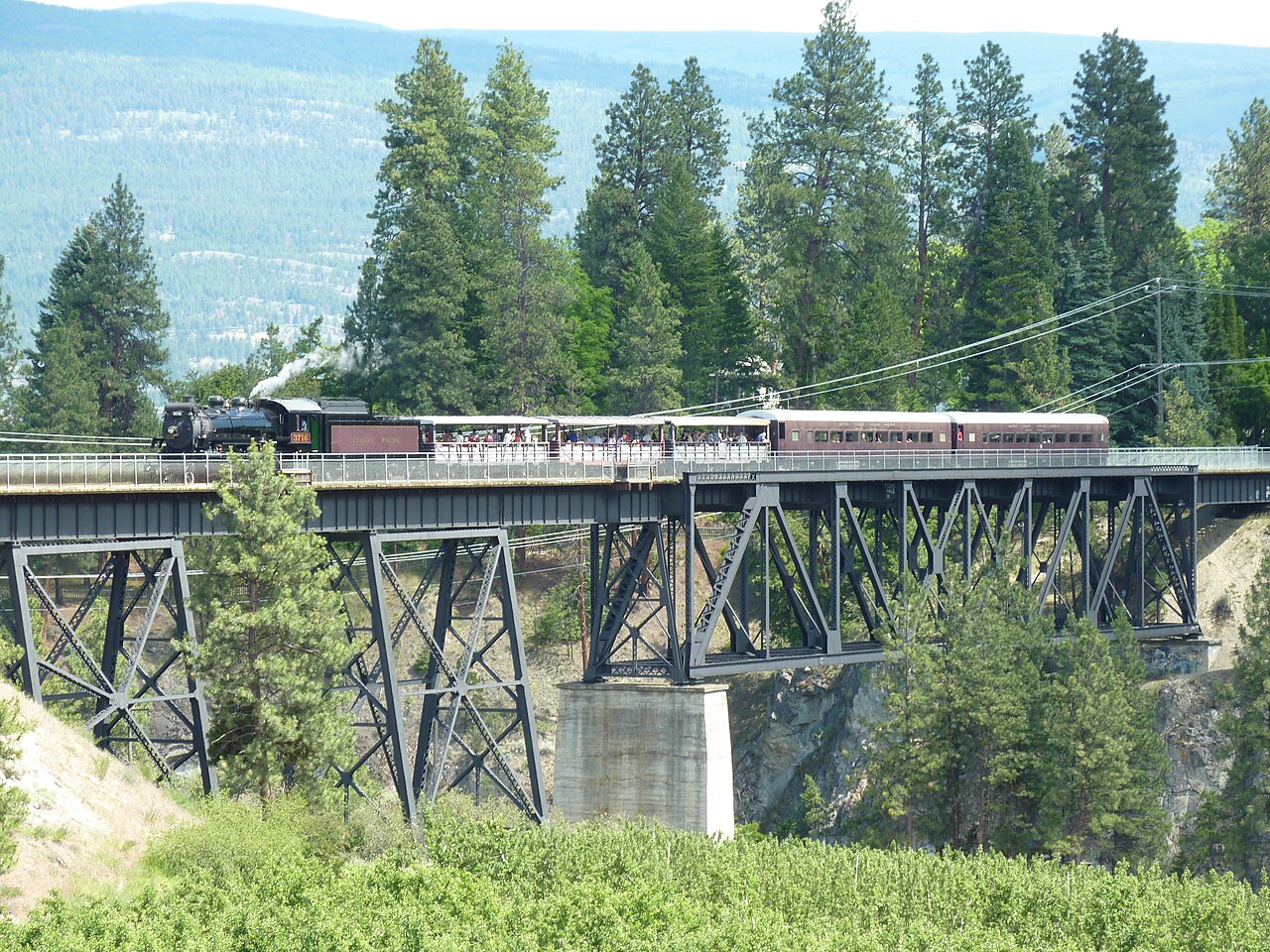

For a final ’90s memory, listen for the train.
The Kettle Valley Steam Railway began welcoming visitors in 1995, giving Summerland a new way to experience an older part of the valley’s history. Preservation work turned a surviving stretch of railway into somewhere families could go for a ride, rather than simply hear about the trains that once ran there.
If you rode in those early years, you were there near the beginning of a new local tradition. It is a fitting place to finish: something from the past kept alive because people believed it was worth sharing with the next generation. Sources: National Trust for Canada, Kettle Valley Steam Railway’s history.
Which place brings you back?
Maybe it is one on this list. Maybe it is a beach, a corner store, a school outing or a place that never made it onto a tourist brochure.
Tell us what you remember in the comments, including the town and roughly which year. And if this has reminded you of a photograph tucked into an album, find it. Sometimes the background of an ordinary family picture contains a whole piece of the Okanagan that is no longer there.
AROUND THE TABLE
Join the conversation.